


🥩🥦 The Hidden Power of Your Food: The Ultimate Guide to Micronutrients
We always talk about proteins, carbs, and fats, but the true architects of your health operate in the shadows. We are talking about micronutrients.
What exactly are they, how does your body process them, and why can a steak give you more nutrition than a bowl of fruit? I’ll explain it all here.
🔬 What are they and what are they for?
Micronutrients are compounds our body needs in tiny amounts, but they are the “ignition” for our metabolism. Without them, there is simply no life. They are divided into two categories:
- Vitamins (Organic compounds): They are essential for energy production, immune system function, blood clotting, and cellular repair.
- Minerals (Inorganic elements): They are the “bricks” and “wires” of your body. They maintain bone structure, regulate fluid balance (hydration), and allow the transmission of nerve impulses.
⏱️ How do we consume them, how long do they last, and how are they eliminated?
Our body extracts these nutrients during digestion. They pass from the intestine into the bloodstream and from there into your cells, where they act as chemical cofactors (meaning they help cells do their job).
Their time in the body and how they are eliminated depends on their type:
- Water-soluble (Vitamin C and B Complex): They dissolve in water. Your body absorbs what it needs and rapidly eliminates the excess through urine. That’s why you need to consume them constantly; they aren’t stored for long.
- Fat-soluble (Vitamins A, D, E, K): They dissolve in fat. These are stored in the liver and fatty tissues. They can stay in your system for months. An excess (usually from supplements, not food) can be toxic because the body doesn’t eliminate them easily.
- Minerals: They are stored in bones, muscles, or the liver. We eliminate them through urine, feces, and, very importantly, through sweat.
👑 The most important ones
Although all are vital, the most critical deficiencies today are usually: Vitamin D (due to lack of sun), Vitamin B12 (vital for the brain), Magnesium (the relaxing mineral), Iron (oxygen transport), and Zinc (immunity and testosterone).
🧬 Context is EVERYTHING: Genetics and Lifestyle
We need to make something very clear here: daily recommendations are just a guide, not a law. Your needs depend entirely on your context and your DNA.
- Lifestyle: A sedentary office worker is not the same as a high-performance athlete who sweats buckets and constantly needs to replenish sodium, potassium, and magnesium. A pregnant woman has sky-high demands for folate and iron. A person with the flu or physical stress will burn through their Vitamin C and Zinc reserves at an impressive rate.
- Your Genetics: Your DNA dictates the rules of the game. Due to genetics, some people have mutations (like the MTHFR variant) that make it difficult for them to absorb certain B vitamins. Others have genetics that make them accumulate excess iron, while others lose it easily. Your genetic code determines how bioavailable a nutrient is to you and how quickly you deplete it.
📊 Daily Recommendation Table (Average Adult)
Note: This table is a general standard. As we saw above, your real requirements vary based on your context.
| Micronutrient | Average Daily Recommendation | Main Function |
| Vitamin D | 600 – 800 IU | Calcium absorption, immunity, mood. |
| Vitamin C | 75 – 90 mg | Collagen synthesis, antioxidant, immune function. |
| Vitamin B12 | 2.4 mcg | Nervous system function, blood formation. |
| Magnesium | 310 – 420 mg | Muscle and nerve function, glucose control. |
| Iron | 8 – 18 mg | Oxygen transport in the blood. |
| Zinc | 8 – 11 mg | Immune system, wound healing, DNA synthesis. |
| Calcium | 1000 mg | Bone health, muscle contraction. |
🥩 Where are the nutrients really hiding?
We’ve been sold the idea that to get vitamins, you have to stuff yourself with juices and fruit. While fruits do have nutrients, often the amount is small in proportion to their fructose (sugar) load, and an excess of sugar in the body causes inflammation and hinders nutritional absorption.
The nutritional reality is this: quality meats and good fats have a massive density of micronutrients, and best of all, they come in their most bioavailable form (your body absorbs them almost at 100%).
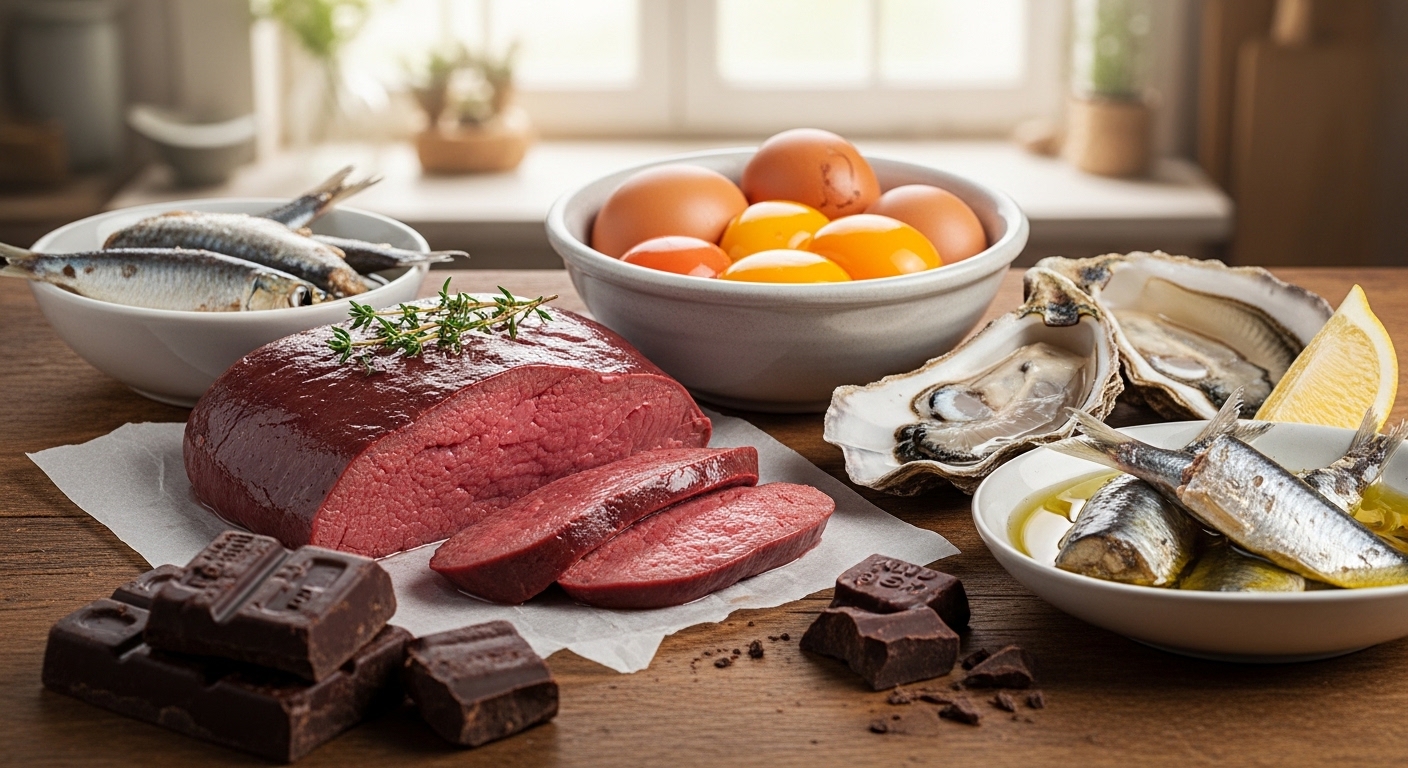
🏆 The TOP 5 most nutrient-dense foods:
- Liver (beef or chicken): It’s nature’s multivitamin. It is massively loaded with Vitamin A, B12, iron, copper, and folic acid. No fruit even comes close in density.
- Egg yolks: A perfect package of fat-soluble vitamins (A, D, E, K), choline (gold for the brain), and minerals.
- Oysters and Sardines: Oysters are the greatest source of Zinc on the planet. Sardines (eaten with the bones) are bombs of calcium, Omega-3, selenium, and vitamin D.
- Fatty cuts of meat (e.g., Ribeye or Picanha): The natural fat in meat isn’t the enemy; it’s an essential vehicle. This fat houses and helps transport fat-soluble vitamins, while the muscle provides proteins, highly absorbable heme iron, zinc, and B-complex vitamins.
- Pure cacao (100% or Cacao nibs): An absolute nutritional beast of the plant kingdom. It is one of the most potent sources of magnesium, iron, copper, manganese, and antioxidants you can give your body (without the sugar of commercial chocolates).
💡 Conclusion: Supplementation doesn’t erase bad habits
Here comes an uncomfortable truth: many people feel tired, lack energy, or get sick constantly, and their first reaction is to believe that taking a vitamin or mineral pill will make them better.
Let’s make it clear: the body and health are a complex system with many variables. It is absolutely useless to take vitamins and minerals if you sleep poorly and don’t ensure restorative sleep. It is useless if you constantly drink alcohol (yes, even if it’s just every weekend), if you are sedentary and don’t exercise, if your diet is based on ultra-processed products, or if you don’t manage your stress and live with your cortisol through the roof.
Why invest and throw away your money on supplements if you are ignoring the basics of biology? Pills do not compensate for a destructive lifestyle.
If you want constant energy, an immune system of steel, and a sharp brain, stop looking for shortcuts. Base your diet on real food, prioritize nutrient-dense sources, understand your own body’s context, and build solid habits. The magic isn’t in the supplement; it’s in what you do every single day.
References & Scientific Evidence
1. Title: Micronutrient bioavailability: concepts, influencing factors, and strategies for improvement
- Description: This scientific article details how the human body absorbs and utilizes vitamins and minerals. It explains the concept of “bioavailability” and how the food matrix determines how much we actually extract and use from what we eat, rather than just focusing on the raw amount consumed.
- URL: https://pmc.ncbi.nlm.nih.gov/articles/PMC12673670/
2. Title: Active Folate Versus Folic Acid: The Role of 5-MTHF (Methylfolate) in Human Health
- Description: A study addressing the importance of genetics in nutrition. Specifically, it explores the MTHFR gene mutation, showing that a significant portion of the population cannot properly metabolize or absorb certain B-complex vitamins, proving that standard recommendations vary based on our genetic code.
- URL: https://pmc.ncbi.nlm.nih.gov/articles/PMC9380836/
3. Title: Nutritional Value of Meat and Meat Products and Their Role in Human Health
- Description: This review highlights quality meat and organ meats (such as liver) as foods with superior nutritional density. It details how these foods provide fat-soluble vitamins, B-complex vitamins (especially B12), and essential minerals in forms that are highly bioavailable to humans.
- URL: https://pmc.ncbi.nlm.nih.gov/articles/PMC12788034/
4. Title: Iron Absorption: Factors, Limitations, and Improvement Methods
- Description: The research explains the crucial difference between heme iron (animal-based) and non-heme iron (plant-based). It supports the claim that the human body absorbs micronutrients from animal products with much greater efficiency compared to other dietary sources.
- URL: https://pmc.ncbi.nlm.nih.gov/articles/PMC9219084/
5. Title: The Sleep-Immune Crosstalk in Health and Disease
- Description: This scientific paper validates that health is multifactorial. It demonstrates how the lack of restorative sleep and chronic stress drastically alter the immune system and trigger systemic inflammation, proving that isolated supplementation cannot compensate for a destructive lifestyle.
- URL: https://pmc.ncbi.nlm.nih.gov/articles/PMC6689741/
Medical Disclaimer: The information contained in this article by Caloritrack (a product of KAI STUDIOS, S.A.S.) is strictly educational and informational. While we encourage empowerment through knowledge, neither Caloritrack nor KAI STUDIOS, S.A.S. acts as a medical entity. This content does not substitute in any way the advice, diagnosis, or treatment of a qualified medical professional. Every body is unique; always consult your primary care doctor or specialist before making significant changes to your diet, routines, or lifestyle.